Celebrating 100 Years of MEA: Women’s History Month
Dear MEA Member,
This year, we are celebrating 100 years of MEA! Going through the archives tells the story of City employees dedicated to both their union and serving the residents of San Diego. It is inspiring to see how far we have come, together.
This month, for Women’s History Month, it seems appropriate to share the remarkable story of one of the first paid staff members of MEA, Mary E. Harvey.
The Early Years
MEA began in the early 1920s as a social club, the Viva Voce Club, that met at 20th and B.
MEA grew into a more formal association in 1926 to help pass and implement a new Charter amendment to establish a retirement benefit for City employees. Back then, City employees had few protections and no benefits and MEA work was performed by members volunteering their time.
The first years were focused on helping shape the new retirement benefits (a matching program), the still evolving Civil Service protections (a few sections had been added to the City Charter in 1899, but they were very basic), and creating the first benefits available to City employees via MEA (City benefits were not available until 1959).
Growing the Union
As the core work of MEA continued to expand, they hired the first paid staff member, a part-time Business Secretary, Elsie Brennan, in 1949. Elsie stayed with MEA until the mid-1960s and her time with us was so dear to her that it was included in her obituary.
In 1951, Ellen Murray was elected as the first woman President of MEA (she was a supervising clerk in the Water Department). Under her leadership in April 1952, MEA hired its first staff member to serve what we now view as the role of the General Manager (called the Executive Secretary back then). Her name was Mary E. Harvey and she played an important role in shaping MEA into the strong member advocacy organization we are now.
Mary E. Harvey, MEA Executive Secretary
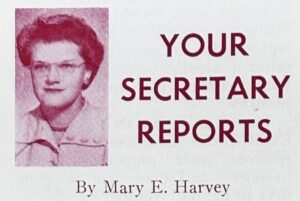 Born in 1919 in Illinois, Mary attended the University of Chicago obtaining an undergraduate degree in history. She then joined the American Red Cross during World War II, serving as an administrator at hospitals in Germany, Austria, Burma, and India. She worked for marketing companies in New York and Seattle before moving to San Diego and becoming the Executive Secretary of the San Diego Municipal Employees Association.
While Mary was working full time for MEA, she was also attending the University of San Diego School of Law part time. She became the first woman graduate of the school in 1959. In fact, it wasn’t until 1964 that a second woman would graduate from USD School of Law.
The January 1956 issue of MEA’s City Employee magazine said,
“Beating the drum for us is Mary Harvey, who as executive secretary, has been doing a singularly fine job since her April 1952 appointment. To see her act in behalf of employees, is to witness statesman-like presentations before the Civil Service Commission, City Manager and City Council. The executive secretary’s stature has grown to the point where she is received favorably not only by City officials. Even recalcitrant taxpayer groups have come to look with favor on her rational judgment. Miss Harvey makes a happy plea for the general welfare of the employees.”
A brief history of MEA published in 1979 said that “Mary Harvey was instrumental in changing MEA so that more representation was given to members for wages, hours, and working conditions”. For example, in the late 1950s, Mary represented MEA at California State Assembly hearings studying whether to give public employee associations the most basic right to meet and confer. That right was passed by the California Legislature in 1961, setting the foundation for full collective bargaining rights for city and county employees in California in 1968. (Note that while the National Labor Relations Act of 1935 gave private-sector workers collective bargaining rights, it has taken much longer for public-sector employees to win the same rights, and it’s been more piecemeal.)
In 1960, Mary Harvey stepped away from the full-time job with MEA and became our Special Consultant. In 1964, she passed the bar. At the time, there were only 63 women lawyers in San Diego.
After MEA
She found obtaining a job to be a challenge. The District Attorney’s office did not hire women as prosecutors, and many law firms were reluctant to hire women. Mary opened her own practice, devoted primarily to criminal defense as well as family and probate law. She practiced in San Diego as a solo practitioner for 30 years.
Mary was active in the San Diego County Bar Association, serving on 18 committees, and was a member of the State Bar Commission for Judicial Nominees. She devoted many hours to civil rights work and served on the legal panel for the San Diego Chapter of the ACLU for 20 years.
One of her legal colleagues described her as a “combination of Ann Richards of Texas and Bette Midler.” Mary is remembered for opening the doors of law and government to women.
The San Diego County Bar Association’s Criminal Justice Memorial Committee names Mary as one of their honorees, which recognizes deceased judges, prosecutors, and defense attorneys who during their lifetimes significantly contributed to criminal justice in San Diego County. She is one of only nine women in 84 honorees. Her name is included on the large granite plaque of remembrance on the 11th floor of the Central Courthouse.
Her friends referred to her as warm and friendly woman who was known to host eclectic community gatherings at her home in La Jolla and including, “musicians, artists, bullfighters, and beach bums”. She was heard to say she was proud of her civil rights work in the 1960s and 1970s.
Mary passed in 2007 at the age of 87.
Have questions? Need assistance?
Your MEA Labor Relations Officers are here for you! Don’t hesitate to reach out to info@sdmea.org or 619-264-6632.
- Cathleen Higgins, chiggins@sdmea.org
- Skyler Coburn-Mercure, smercure@sdmea.org
- Kierstyn Walton, kwalton@sdmea.org
- Nick Wright, nwright@sdmea.org